For iPhone and Apple Watch

Climb four peaks. Know by minute two.

The Norwegian 4x4, coached by your heart rate.

Four rounds of 4 min at 90 to 95 % of your max heart rate. During each round, Fjell tells you whether you will reach the zone by 2:00, while there is still time to push. The recap draws every round as a peak.

Coming soon to the App Store, for iPhone and Apple Watch.

See the halfway check

7 days free, then 2.99 a month or 19.99 a year.

The free trial is for new subscribers. Same prices in USD, CAD and EUR, local prices elsewhere.

The halfway check as the app shows it, for a max heart rate of 186 bpm.
Target: 90 to 95 % of max heart rate Heart rate A modelled session for a max heart rate of 186 bpm.

The halfway check

Know before halfway.

When a hard round starts, your heart rate takes a while to climb. Fjell watches the climb and tells you, while there is still time to push, whether you will be in the zone by 2:00.

Work

Time leftRound 1 of 4

0:00

In zone after 0:52

Heart rate

176 bpm

In zone Last 30 seconds. Give it everything.

Good start: heart rate climbs from 126 bpm and reaches the zone after 0:52, before the halfway check at 2:00. The round ends at 176 bpm, in the zone.

Heart rate across the round. Green band: the zone, 167 to 177 bpm.

What Fjell says

  1. 0:00“Round 1 of 4. Go. Target 167 to 177.”
  2. 2:00“Halfway. In zone.”

The halfway check is Fjell's own rule of thumb, built on how oxygen uptake catches up at the start of a hard interval. It has not been tested as a standard. Read the science.

A simulated round for a max heart rate of 186 bpm, so the zone is 167 to 177 bpm (90 to 95 %). The 4 min round plays in about 12 s.

Your zones

Your zones, in bpm.

Every zone is a share of your max heart rate. Enter your age, or your max heart rate if you know it.

years

15 to 90 years

bpm

140 to 220 bpm, the range Fjell accepts. When you enter it, it replaces the age estimate.

Max heart rate 186 bpm

An example. Enter your age or your max heart rate.

  • Work167 to 177 bpm90 to 95 % of max
  • Recovery93 to 130 bpm50 to 70 %, about 70 % in the trialled protocol
  • Warm-up112 to 140 bpm60 to 75 %
  • Cool-down93 to 121 bpm50 to 65 %

The formula, 208 − 0.7 × age, comes from 351 studies covering 18,712 people and was confirmed in a lab test of 514 more (Tanaka, Monahan, Seals, J Am Coll Cardiol 2001;37:153–156). It describes the average: individuals differ, and a measured maximum beats a formula. Fjell uses your hardest sustained effort from Apple Health when there is one, or a number you set. Nothing you type here leaves this page.

A session, step by step

40 min, start to finish.

A 10 min warm-up, four rounds of 4 min with 3 min of easy recovery between them, and a 5 min cool-down. Fjell talks you through every change, over your music.

  1. 0:00

    Warm-up

    10 min at 60 to 75 % of max heart rate

    • Warm up. 10 minutes.
    • At 9:5010 seconds. Round 1 next. Then 3, 2, 1, with beeps.
  2. 10:00

    Round 1

    4 min at 90 to 95 %

    • Round 1 of 4. Go. Target 167 to 177.
    • At 2:00 into the roundHalfway. In zone. or Halfway. Not in zone yet. Push a little harder.
  3. 14:00

    Recovery

    3 min at 50 to 70 %, easy, still moving

    • Recovery. 3 minutes. Keep moving, easy.
  4. 17:00

    Rounds 2 to 4

    4 min each, with 3 min of recovery between

    • Round 2 of 4. Go.
    • Round 3 of 4. Go.
    • Last round. Go.
  5. 35:00

    Cool-down

    5 min at 50 to 65 %

    • Cool down. 5 minutes.
    • At 40:00Workout complete. Nice work.

Every change gets the same heads-up 10 s ahead and a 3, 2, 1 countdown with beeps. With Apple Watch, you also feel a tap on your wrist. Targets shown for a max heart rate of 186 bpm. Rounds, lengths and zones are all adjustable in Tune.

The app

Built for the hard minutes.

Time on top. Heart rate below.

The running screen is two instruments: time left on a block in the colour of the stage, and your heart rate under it, against the zone. The status line under the clock carries the halfway check.

  • Green in the zone, amber above it, ink below it, always with an arrow or a tick, so colour is never the only signal.
  • Voice cues and beeps play over your music and podcasts, also with the screen locked.
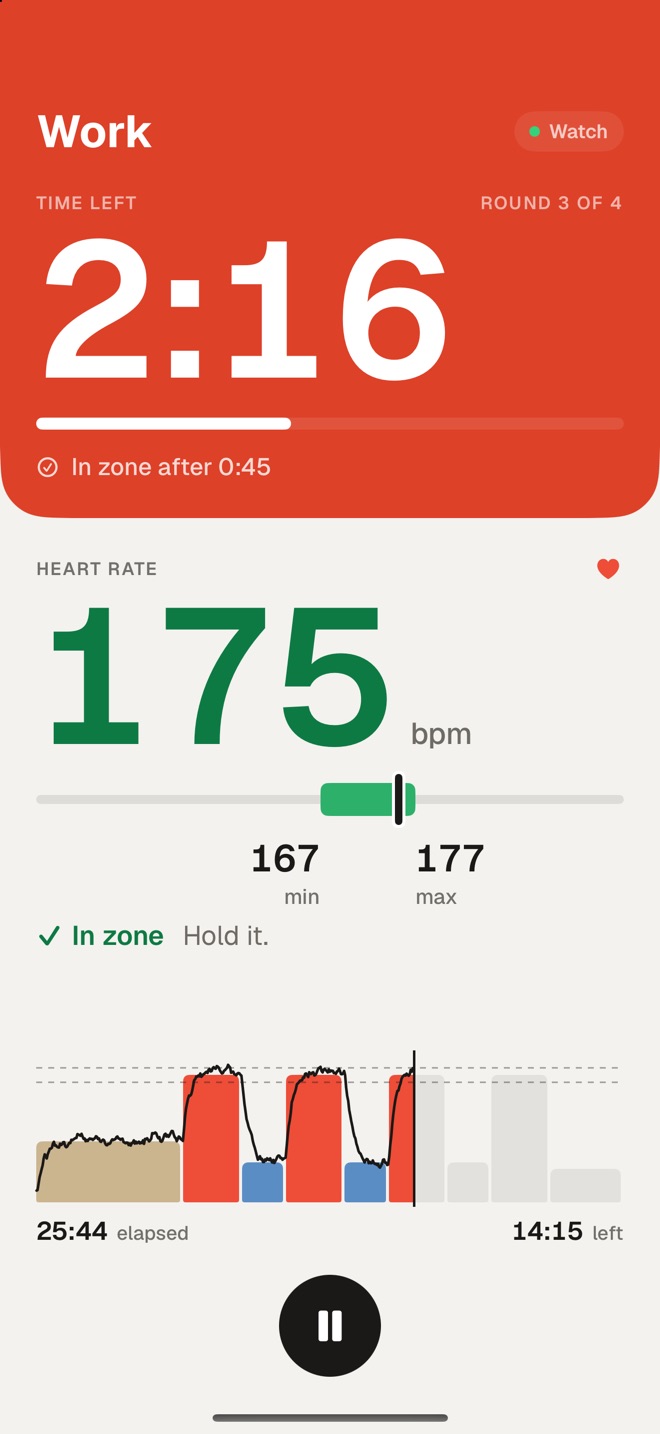
Fjell's running screen during a work round: time left on the red work block with the halfway status under it, and heart rate in the zone below, in green, with its gauge.

On the lock screen and on your wrist.

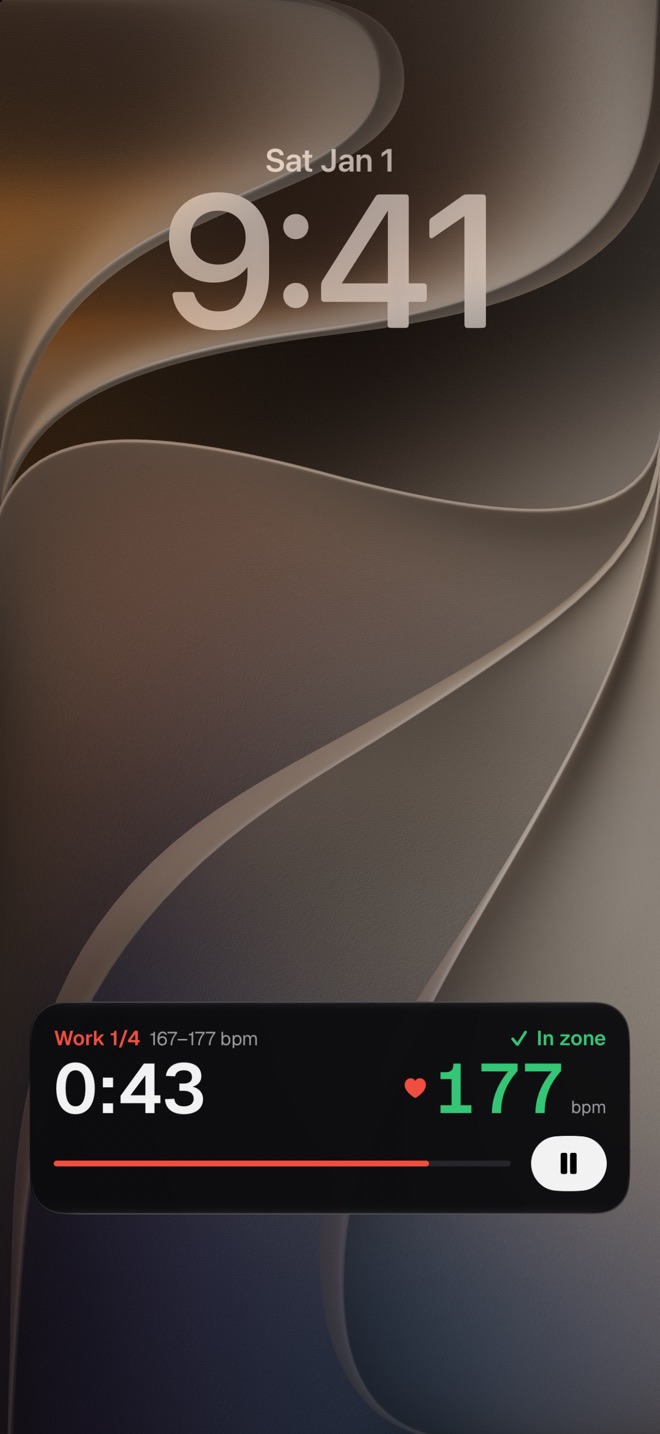
A Live Activity and the Dynamic Island show the stage, the time left and your heart rate, with a pause button. Apple Watch gives a haptic before every change, so you feel it coming.

  • Pause from iPhone, Apple Watch or the lock screen.
  • Start on iPhone, and Fjell opens on Apple Watch by itself.
An iPhone lock screen with Fjell's Live Activity: the work round, the time left, heart rate in green, in the zone, and a pause button.

Every round, drawn as a peak.

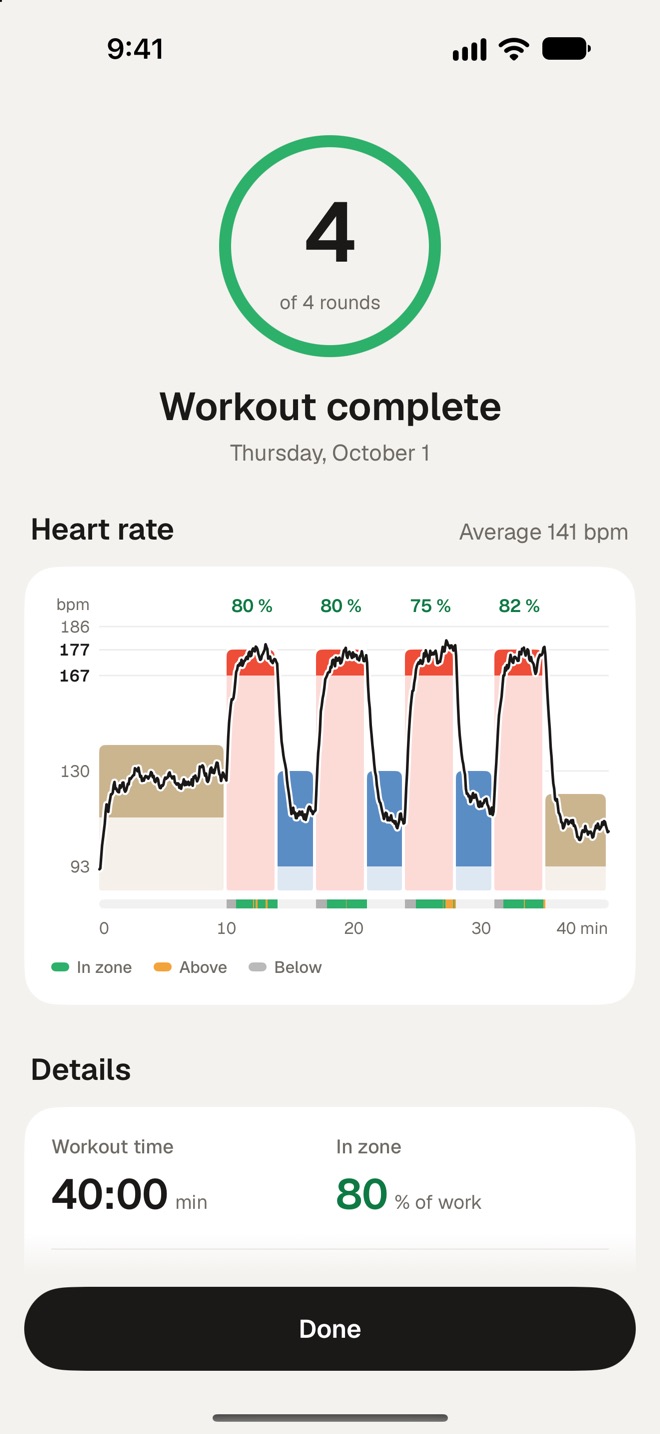
The recap draws your heart rate over the plan, with the time in zone above every round. Each round gets its time to zone and its halfway verdict.

  • Streaks count only completed 4x4s, with every planned round finished.
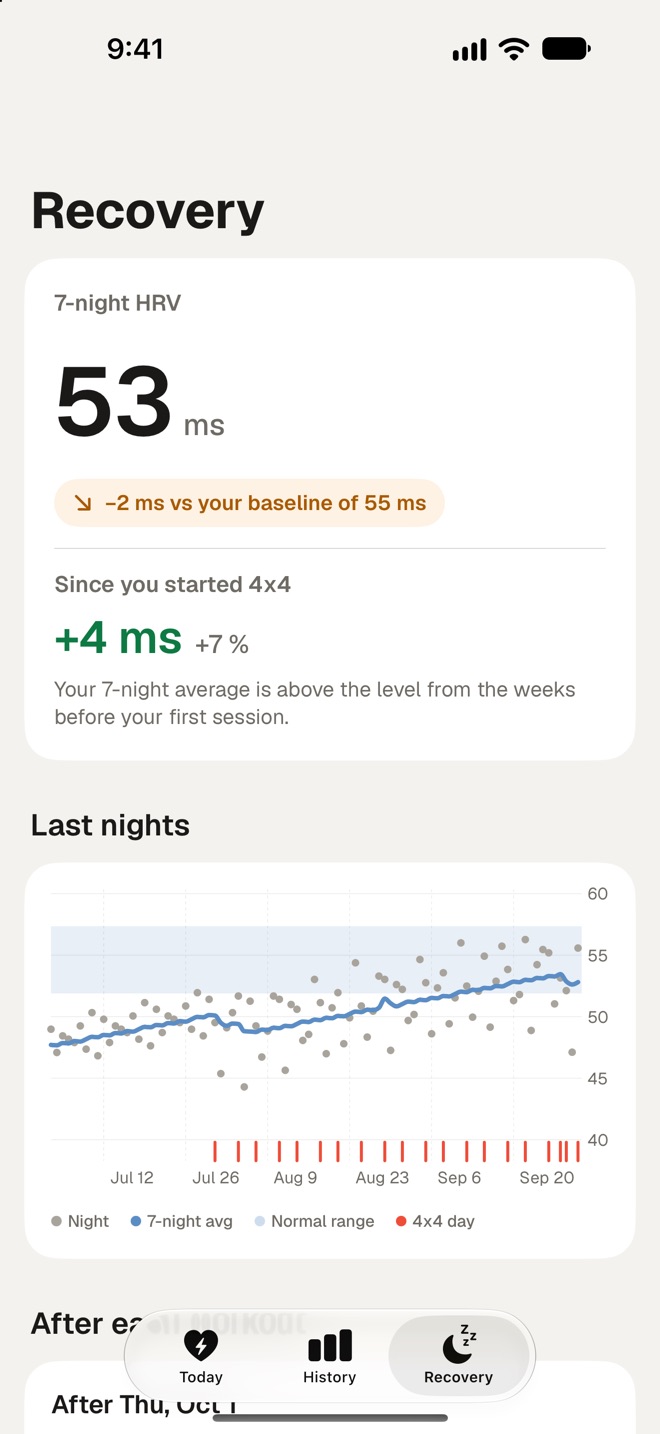
  • See how you recover from each session: your overnight HRV against your own baseline, as a 7-night average. A dip after a hard session is normal, and shown as such.
  • Workouts are saved to Apple Health, with the intervals marked.
Fjell's recap: the heart-rate line over the plan, rising into four red work blocks like four peaks, with the time in zone above each round. Fjell's Recovery screen: overnight HRV as a 7-night average against your own baseline, with a chart of recent nights and the 4x4 days marked.

The science

What the research shows, and what it does not.

Every figure here is from the abstract of the paper it cites. Where an idea is Fjell's own, it says so.

What the studies show

Hard intervals raised VO₂max more than the same work done easier.

In a trial of 40 healthy men, 4 x 4 min at 90 to 95 % of max heart rate, 3 times a week for 8 weeks, raised VO₂max by 7.2 %. The same total work at 70 % or 85 % of max heart rate raised it significantly less (P < 0.01). Stroke volume rose about 10 % and tracked the VO₂max gain.

Caveat: healthy, moderately trained men, over 8 weeks.

It holds up across trials, with a small edge over steady training.

A meta-analysis of 28 controlled trials in 723 healthy adults aged 18 to 45 found that high-intensity intervals improved VO₂max by about 1.2 mL/kg/min more than continuous endurance training. Both beat no exercise: by 5.5 and 4.9 mL/kg/min.

Caveat: the edge is small. Both work.

Aerobic fitness goes with a longer life.

Across 33 cohort studies, with about 103,000 people in the death analysis, each 1-MET higher aerobic capacity (about 3.5 mL/kg/min) went with a 13 % lower risk of death from any cause. Low fitness carried a 70 % higher risk than high fitness.

Caveat: an association from observational studies, not proof that training causes it.

HRV changes slowly, and it is personal.

Training raises the part of heart rate variability linked to vagal tone (13 studies, effect size 0.48). After one hard session, the heart's autonomic recovery takes at least 48 hours, so a dip the next day is expected. That is why Fjell shows a 7-night trend.

Caveat: HRV is personal, and in very fit athletes it can fall as fitness rises.

What we infer

Why Fjell wants you in the zone by halfway.

Oxygen uptake takes time to catch up when a hard interval starts. Intervals are thought to work best with several minutes a session above about 90 % of VO₂max. Being in the zone by halfway leaves the second half of the round at target.

Caveat: The halfway check is Fjell's own rule of thumb built on this. It has not been tested as a standard.

How Fjell sets your max heart rate.

Every zone is a share of your max heart rate. Fjell takes your best 30-second heart rate in Apple Health over the last 6 months. If that is under 92 % of the age formula, 208 − 0.7 × age, it uses the formula instead. Or you set the number yourself.

Caveat: the 30-second window and the 92 % bar are Fjell's own choices. The formula describes the average; a measured maximum beats it.

What is not proven

  • In the five-year Generation 100 trial in older adults, the group assigned to interval training had a lower death rate than the control group, but the difference was not statistically significant. Stensvold et al., BMJ 2020;371:m3485
  • Fitness going with a longer life is an association, not proof that training causes it.
  • The halfway check is Fjell's own rule of thumb. It has not been tested as a standard.
  • HRV is a trend, not a score. Single nights are noisy.

More on the Norwegian 4x4 and the research behind it

Why pay for it

Why not a free timer?

A timer counts the minutes. Fjell watches your heart rate through them and tells you, mid-round, whether you'll make the zone.

What a plain interval timer, the Workout app on Apple Watch and Fjell each do for a 4x4
Interval timer Workout app Fjell
Times 4 rounds of 4 min with 3 min recovery Yes Yescustom workout Yes
Heart rate against your 4x4 zone No Yesrange alert Yes
Tells you mid-round whether you will be in the zone by halfway No No Yes
Time to zone for every round No No Yes
Streaks that count only finished 4x4s No No Yes
Your HRV the night after each session, against your own baseline No No Yes
Price Often free Built in 2.99 a month

Workout app: Apple's Workout app on Apple Watch, set up as a custom workout with a heart-rate range alert. Fjell's yearly plan is 19.99 a year.

Price and privacy

One subscription. No account.

Price

7 days free, then 2.99 a month or 19.99 a year. Cancel anytime in Settings.

What you pay for: the live halfway forecast, heart rate against your own zones, coaching on the lock screen and Apple Watch, recaps, streaks and recovery. No ads, no account, no tracking.

  • The yearly plan works out at about 1.67 a month.
  • The free trial is for new subscribers.
  • Same prices in USD, CAD and EUR, local prices elsewhere.
  • One subscription unlocks everything.
  • The subscription renews unless you cancel at least 24 hours before the period ends.

Privacy

Your data stays on your iPhone and in Apple Health.

  • No account and no sign-in.
  • No analytics, no ads, no tracking and no third-party code.
  • The developer receives no personal data.

Read the privacy policy

FAQ

Questions

Do I need an Apple Watch?

No. Timer only gives you the voice cues, the beeps and the countdown, without heart rate. Apple Watch adds live heart rate, the halfway check, haptics on your wrist, and the overnight HRV that Recovery reads.

Which iPhone and Apple Watch?

An iPhone with iOS 18 or later. Apple Watch is optional and needs watchOS 11 or later.

Does it work with my music?

Yes. Cues and beeps play over your music and podcasts, also with the screen locked. To have the music dip while Fjell speaks, turn on Lower music during cues in Tune.
How do I cancel?

Open the Settings app, tap your name, then Subscriptions, Fjell, Cancel Subscription. Cancel at least 24 hours before the current period ends, or the subscription renews.

Is it safe for me?

The 4x4 is hard. If you have a heart condition or other health concerns, talk to a doctor first. Fjell is not medical advice.

If you are new to hard training, start easier, with fewer rounds or a lower zone (both are in Tune), and stop if you feel unwell.

Where can I do it?

Anywhere you can work hard for 4 min at a time: on a treadmill, up a hill outdoors, on a bike, a rower or cross-country skis, or on stairs.

More answers on the support page.